
Lots of Rocks: Petrified Forest National Park, Arizona
November 12, 2011 No Comments
Petrified Forest National Park is seemingly in the middle of nowhere
When Dad and I headed to the American Southwest this summer, we had very different ideas on what we would see. My vision of the West was filled with the organ pipe cactus, an imposing species that can grow more than 20 feet tall. Dad is a huge fan of old Westerns, particularly Bat Masterson and The Lone Ranger. Based on those shows, his vision included rocky vistas filled with mountains and rock outcroppings as far as the eye could see.
Of course, like any stereotype, both our visions proved to be half-truths. I did indeed see organ pipe cacti, and many other cactus species as well. But the West was far from overrun with them. Likewise, Dad saw his fair share of steep rock outcroppings, but plenty of level plateaus covered with vegetation as well. Nonetheless, Dad’s inner child cried out with delight when we reached Petrified Forest National Park in northeastern Arizona.
About Petrified Forest National Park

The Petrified Forest is visually stunning
The Petrified Forest was already ancient when the first human settlers arrived approximately 15,000 years ago. Although it is impossible to precisely pin down the ages of the petrified logs, the National Park Service estimates that the oldest logs date to roughly 218 million years ago. The trees stood roughly 200 feet tall when alive, though most of the logs have been broken down by age and weather. They are considered petrified because most of the organic material was replaced by silica and other minerals carried in volcanic ash.
The region was initially explored by nomadic Paleo people more than 13,000 years before Christ. Then a cool grassland region, the area was perfect for hunting large game. By approximately 4000 BC, the climate shifted to provide alternating dry and wet seasons, making the region a good choice for farming. But the Petrified Forest was depopulated around 1450 AD due to an extended drought. The first known European settlers arrived in the late 1800s, although there is some evidence that Spanish explorers may have passed through the region as early as the 1600s.
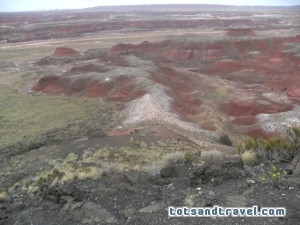
The sheer number of different colors was breathtaking
As Westward expansion continued, transport routes were developed along the 35th parallel. A wagon trail through the Petrified Forest eventually became a stagecoach route and then a railroad line. In 1926, a secondary trail built along the railroad tracks became a part of the now-famous Route 66. Although some sections of Route 66 remain open to traffic, Interstate 40 has fully replaced Route 66 in this part of Arizona. However, the park retains a tribute to the Mother Road along its original route.
As early as the late 1800s, preservationists were concerned about the amount of tourist traffic arriving in the Petrified Forest. Souvenir hunters and entrepreneurs carted off vast quantities of the wood. In 1906, President Theodore Roosevelt signed the Antiquities Act, which was soon used to designate the Petrified Forest as a national monument.
The Petrified Forest lies along the edge of the Painted Desert, a 146 square mile stretch of badlands that got its name from the stunning colors of its rocks and mountains. From 1934 to 1942, the Civilian Conservation Corp (CCC) installed roads, trails and structures throughout the monument site. The site also expanded to include portions of the Painted Desert and, in 1962, the area was declared a national monument. As of 2011, the park is in the midst of a further expansion that will eventually encompass more than 200,000 acres.
Visiting Petrified Forest National Park
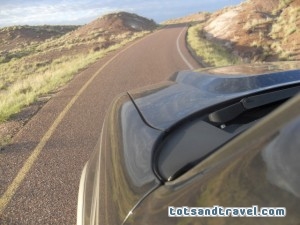
Driving the Scenic Loop was fun
As of 2011, Petrified Forest National Park is open 7 am to 7 pm during the summer months and shorter hours the rest of the year. The Painted Desert Inn, located within the park, is open 9 to 5 year-round. Admission is $10 per carload, valid for seven consecutive days. National Parks passes are honored. When planning your visit, note that Arizona does not observe Daylight Saving Time, but remains on Mountain Standard Time year-round.
Although the park offers opportunities for backcountry hiking and camping, most visitors choose to concentrate their time along the 28-mile scenic drive. There are numerous pull-outs and short walking trails ranging from easy to strenuous. The Painted Desert Visitor Center and Rainbow Forest Museum, at opposite ends of the scenic drive, offer museum-style exhibits and a 30-minute introductory film. The Painted Desert Inn is now a National Historic Landmark, while the Puerco Pueblo and Newspaper Rock offer the chance to view a partially restored ancient pueblo and a series of petroglyphs.
Our Experience
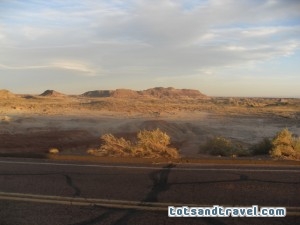
The route to the park had its own special charm
For various reasons, we did not make it to Petrified Forest National Park until late September. In startling contrast to the excessive heat we experienced during our mid-summer drive through Arizona, the weather was relatively cold. On the day of our visit, the temperature fluctuated from the low 50s to the low 60s F with a stiff wind.
Many national parks require visitors to park their cars and take a shuttle bus along the main route. As of 2011, Petrified Forest National Park does not offer shuttle buses. The park roads are well-maintained and easily navigated by even large RVs, but we took just our car.
We were base camping at a membership RV park three hours away, so we did not arrive until approximately 11 a.m. There are RV parks and campgrounds as well as motels in Holbrook, roughly 20 miles from the Petrified Forest, which serves as a sort of gateway town.
Our GPS told us to take Interstate 40 all the way to the exit for the park, but road signs told us to turn much sooner. As it turns out, following the signs took us through Holbrook. It is a neat old-fashioned town and well worth seeing. We would choose to go that way again, though it probably added 30 minutes or so to our drive.
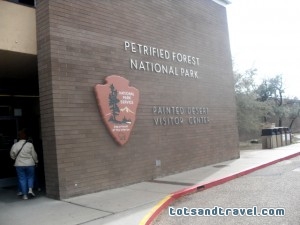
Don't miss the Painted Desert Visitor Center!
Dad has a National Parks pass, so we did not need to pay an entry fee. We picked up a free map and brochure at the fee station and began planning our day. The 28-mile scenic road is an out-and-back rather than a loop, so we decided to drive to the far end and make our way back. The far end is the Painted Desert Visitor Center which, as our GPS instructed, has its own exit from the interstate.
Interestingly, the Painted Desert Visitor Center is just outside the official National Park border. So we had to pass through the guard shack/fee station in both directions. As we exited the park land, the ranger asked if we had collected any petrified wood inside the park. Apparently this question is very necessary as, despite posted warning signs prominently displayed throughout, approximately 12 tons of petrified wood are stolen each year.
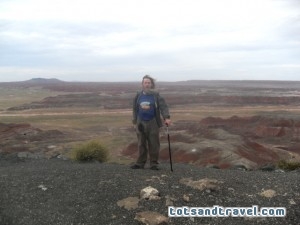
The drive offers numerous scenic overlooks
Inside the visitor center, we chatted with a ranger and took a quick look at the museum displays before viewing the orientation film. The free film gives an excellent overview of the park and its history, and is engaging for even the youngest viewers. It is shown throughout the day at both the Painted Desert Visitor Center and the Rainbow Museum, allowing visitors at both park entrances to see it before beginning their day.
Passing back through the guard shack, we decided to stop at every scenic overlook and historic building. Due to the increasingly cold temperatures, though, we opted to skip the hikes. We weren’t entirely sure what to expect from the Painted Desert portion of the park, but the views were truly unbelievable! The longer we stared at any particular section, the more colors we noticed. Pinks, reds, blues, greens, yellows, oranges, even purples–it was easy to see why it is called the Painted Desert!
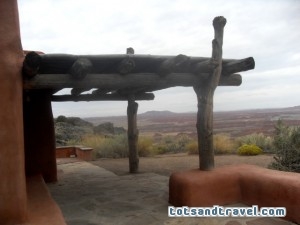
It must have been amazing to stay at the Painted Desert Inn
The Painted Desert Inn was long a stop for travelers passing through the region. Built by the CCC in 1937 on the site of the former Stone Tree House, the inn was, for its time, a marvel of modern engineering and design principles. Architect Mary Colter, well-known for her work on national park lodges throughout the American Southwest, upgraded the building in 1947. Entrepreneur Fred Harvey then acquired the Inn, which he operated as one of his well-known Harvey Houses, staffed by the professional yet wholesome Harvey Girls. The Inn closed in 1963 and was nearly demolished in the 1970s, but was saved by preservationists. Today it serves as a museum, bookstore and gift shop.
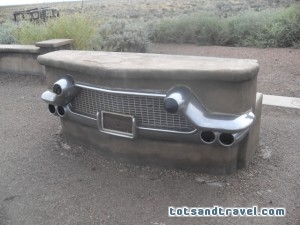
The Route 66 Tribute was a particularly fun stop
We stopped at several more overlooks before the tribute to Route 66. Although the old Mother Road no longer exists in this area, the park has done a remarkable job of recreating the feel. A series of power poles marks the former road boundaries, while a small display tells the story of the historic route.
This stop marked the end of the Painted Desert portion of the park and the beginning of the Petrified Forest. The sweeping vistas of brightly colored rock were replaced by an up close and personal experience with 200 million-year-old preserved logs.
We wanted to tour Puerco Pueblo, a partially excavated Native American dwelling, but the wind was intense and we were running short on time. We did stop in the parking lot for a few photos just in time to watch two trains pass along the nearby tracks.
Newspaper Rock involved a short stroll to an overlook with an excellent view of ancient petroglyphs. Having recently visited the Three Rivers Petroglyph Site near Alamogordo, New Mexico, where we clambered up a rocky mountainside to view hundreds of petroglyphs, we did not stay too long at Newspaper Rock. If you have never seen these amazing ancient artworks, though, it is well worth your time.
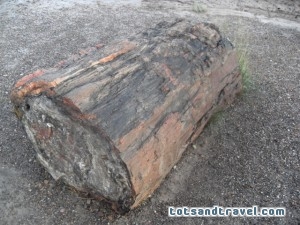
The Crystal Forest let us get up close and personal with the petrified wood
By the time we reached the Crystal Forest, it was almost time for the Rainbow Museum to close and the temperature was dropping rapidly. We did get a few photos, but I would love to have the opportunity to explore it in more detail. The sheer concentration of petrified wood in this area is just breathtaking.
We slipped into the Rainbow Museum with minutes to spare. The museum displays looked fascinating, but we barely had time for a few quick photos. The Giant Logs trail outside looked spectacular, but it was already closed.
Tips for Parents
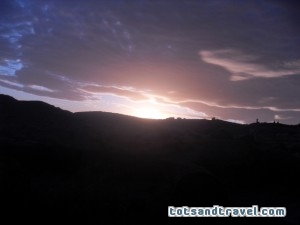
Sunset over the Painted Desert was a special treat
Allow two days to see Petrified Forest National Park if at all possible. We were overwhelmed by the sheer amount of time that it took to fit everything in. There are ranger programs, hiking trails and a cafeteria as well as the main stops.
Dress appropriately for the weather, as you will spend much more time out of your car than in it. Carry plenty of water. In the very low humidity, it is easy to get dehydrated even on a chilly day.
Keep a close eye on your kids and do not allow them to wander off the marked trails. The fragile ecosystem in the park is easily damaged. Most of the paths are paved and many have railings, but falls have occurred. Wear sturdy, closed-toe shoes such as sneakers or boots rather than flip flops or sandals.
Be prepared for questions. The beauty of both the Petrified Forest and the Painted Desert are sure to spark the imaginations of both kids and adults. Informational signs are provided at every stop.

|
 About the Author:
Sorry, the comment form is closed at this time.