
Law and Order? Tombstone Courthouse, Arizona
August 11, 2011 No Comments
Tombstone was a haven for both outlaws and lawmen
Tombstone, Arizona, is inextricably linked to the Gunfight at the O.K. Corral. More than perhaps any other gun battle, that one is seen as representative of the lawless Western frontier. It elevated Marshal Wyatt Earp to mythic hero status in legend and lore, despite the fact that at the time, most of the townspeople sympathized with the Cowboy gang. The Earps stood trial for murder but were ultimately exonerated.
Dad and I love a good mystery, and we were eager to dig further into the topic of law and order in Tombstone. As is true throughout the Old West, things in Tombstone were not nearly as cut and dried as Hollywood would have us believe. Part-time lawmen they may have been, but the Earp contingent and their pal Doc Holliday were in their time at least as well-known for their criminal exploits as for their lawful ones. Gunfighters and gamblers with a long list of charges in multiple states, their records were no cleaner than those of the outlaws they publicly sought to eradicate. In fact, the O.K. Corral fiasco was apparently more of a standoff between rival gangs than any sort of morally-induced arrest attempt.
Regardless, the time of the Earps was over. Morgan Earp was assassinated in March 1882. Following a vendetta ride, Wyatt and Virgil left Arizona never to return, as did Doc Holliday. But their lives were forever marked by the gunfight. Meanwhile, Tombstone was tired of the violence.
Tombstone Courthouse
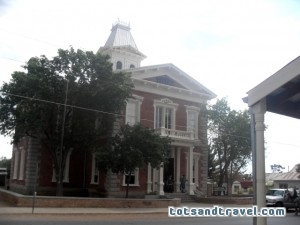
Tombstone finally got a courthouse in 1882
Even before the gunfight, it was clear that Tombstone was sorely lacking in any sort of legal establishment. Guns were actually banned in Tombstone at the time. Beginning in 1880, visitors could carry guns into town, but were required to check them at the hotel or sheriff’s office. The topic of firearm carrying actually factored into the Earp trial, as the faction protested that they were serving as legally-armed representatives of the law rather than illegally-armed vigilantes.
But who could actually enforce the gun laws? At the time, the nearest government buildings were a two-day ride away in the county seat of Tucson or the territorial capital of Prescott. Yet Tombstone’s population was at least as high as that of either neighboring town. In 1881, Cochise County was created and Tombstone named its county seat.

The old courtroom has been preserved
A shiny new courthouse opened in 1882. But for every dedicated lawman like John Slaughter, there were many more of questionable backgrounds, including Deputy Sheriff Burt Alvord. Apparently Alvord couldn’t ever quite pick a side. As a teenager, he was part of the lynch mob that hung John Heath on the streets of Tombstone, but he became a serious lawman under Slaughter a few years later. Then he decided he preferred the company of outlaws, and left the law enforcement business to start his own gang.
Tombstone’s boom years lasted less than a decade. By the end of the 1800s, the mines were full of water, the price of silver was down, and most residents had moved away. Despite a valiant effort by the few who remained, the county seat moved to nearby Bisbee in 1929. The last offices at the courthouse closed in 1931.
Tombstone turned to tourism to survive, and by the 1950s the town was regularly drawing visitors eager to experience the Wild West. In 1955, the Tombstone Restoration Commission took over the old courthouse. It opened as a museum under the purview of the Arizona State Parks system in 1959, the first state park to open in Arizona.
Visiting the Tombstone Courthouse
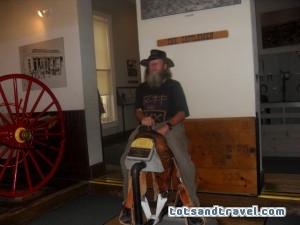
Take photos of yourself or the kids on an old Western saddle
As is true across the United States, the Arizona State Park system faced a serious budgetary crisis in 2010 and 2011, forcing major cuts. The Tombstone Courthouse was on the short list of spots designated for closure, but the Tombstone Chamber of Commerce and the City of Tombstone stepped in. As of 2011, the Courthouse is open from 9-5, 7 days per week. Admission is $5 for adults, $2 for kids aged 7 to 13, and free for those aged 6 and under. The courthouse is located at the corner of 3rd and Toughnut Street.
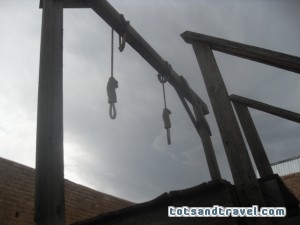
An ominous gallows stands in the quiet courtyard
The Courthouse is filled with artifacts and informational signs that tell the story of Tombstone’s history. Numerous displays are dedicated to the story of law and order, including a massive law library. The old courtroom has been preserved. However, there are also entire rooms dedicated to both Native American and pioneer history in the region. One former jail cell has been preserved, while the rest of the cavernous room is filled with mining equipment and various wagons.
Outside, a replica gallows stands grimly in the quiet courtyard. The original burned in 1912. Interestingly, despite Tombstone’s reputation for violence, only seven men were lawfully hung in town.
Wyatt Earp House and Gallery

The restored Wyatt Earp House is now an art gallery
At the corner of 1st and Fremont, just a short walk from the courthouse, is the Wyatt Earp House and Gallery. Today the building is 756 square feet, consisting of two houses that were pushed together sometime after the Earps left Tombstone. Wyatt lived in the 376 square foot adobe portion of the building.
Exactly what happened to the house between the time Wyatt left in 1882 and the time Jim Allen discovered it in 2003 is not entirely clear. What is known is that Jim and his wife Liz put a great deal of time, effort and love into the building’s restoration. Needing to recoup some of their money, but wanting to open the home to the public free of charge, they eventually settled on a solution. They opened an art gallery in the historic building.
It is perfectly acceptable to visit solely for the history without a desire to browse the art. As we walked in the door, we were greeted by a friendly woman who shared the history of the building with us. There are photographs of the restoration available for viewing, and she was happy to answer all the questions we had about the home.
Tips for Parents
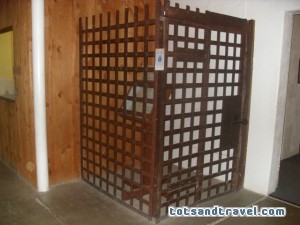
The jail cell was creepy but cool
Packed with thousands of artifacts, the Tombstone Courthouse is a must-see for those with even a passing interest in history. A traditional museum with written signage rather than multimedia exhibits, the Courthouse retains visual interest for even the smallest child. Try to read and summarize the information for younger kids.
Follow your kids’ lead. It would be impossible to fully read and digest all that the courthouse offers in even a series of visits, so focus on the things that draw your kids’ attention. You can make a cursory pass through the entire courthouse in an hour or so, but those with a deeper interest should plan for at least two hours.
The Wyatt Earp House and Gallery takes just a few minutes to see, but is well worth a visit. In today’s culture of suburban sprawl, both kids and adults are generally shocked to see just how little space the average family home provided. The restoration photographs are quite interesting to see. It is clear that the current owners love the home, and they love showing it off to visitors of all ages. This is definitely not a snooty or exclusive art gallery, and children are always welcome.

|
 About the Author:
Sorry, the comment form is closed at this time.