
Tombstone, Arizona: The Town too Tough to Die
August 8, 2011 No Comments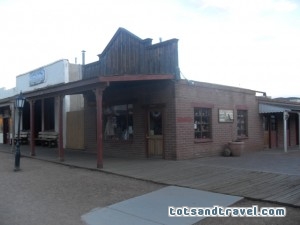
Tombstone is filled with original buildings
I am a huge fan of Colonial Williamsburg, Virginia, a living history center focusing on the Revolutionary War era. I love the experience of walking the historic streets as reenactors draw me into the lives of the people who founded this country. Consequently, when Dad and I decided to visit the American Southwest, Tombstone, Arizona was at the top of my list.
One of the best-preserved Old West boom towns in the country, Tombstone celebrates its history with a wide variety of performances and historic tours. I hoped that Tombstone would give me the same feeling of historic immersion that I get in Colonial Williamsburg, and the town did not disappoint.
About Tombstone
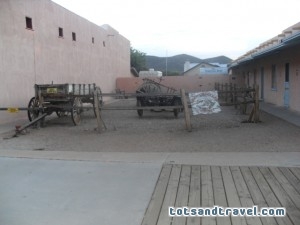
The mountains around Tombstone were filled with silver mines
In 1877, prospector Ed Schieffelin set out from Camp Huachuca, Arizona into dangerous Apache territory, determined to find silver. Soldiers jeered at him, telling Ed that the only thing he would find in those mountains was his own tombstone. When Schieffelin discovered a major silver vein, he decided to give the claim the ironic name of “Tombstone.” Then known as Goose Flats, the town changed its name to Tombstone in 1879.
The Tombstone claim was just the first in a long line of successful mining operations. During the 1870s and 1880s, the mines produced an estimated $85 million in silver. The town of Tombstone quickly grew into a boom town with an opera house, multiple banks and newspapers, a variety of shops and restaurants, and churches representing each of the major Christian denominations.
Boom towns also appealed to the seedier elements, and Tombstone was no exception. The town boasted 14 gambling halls, more than 100 saloons and dozens of brothels. In 1881, the Bird Cage Theater opened its doors, quickly drawing a reputation as the wildest night spot in the West.
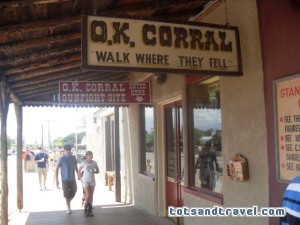
The O.K. Corral shootout is synonymous with Tombstone
Shootouts were frequent in Tombstone’s early history, as Cowboys (which in those days referred to a loosely organized gang of outlaws) clashed with lawmen. Tombstone’s most famous shootout is now known as the Gunfight at the O.K. Corral, though the fight did not actually take place inside the corral. On October 26, 1881, the Earp lawmen faced off against the Cowboy gang of the Clantons and McLaurys.
Within seconds, the battle was over. Brothers Tom and Frank McLaury were dead, along with Billy Clanton. Cowboys Billy Claiborne and Ike Clanton had fled from battle. Virgil and Morgan Earp were injured, as was Doc Holliday. Wyatt Earp alone emerged unscathed. The Earps were later indicted for murder, as witnesses testified that the Cowboys were in the process of surrendering, but they were ultimately cleared.
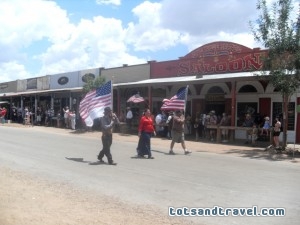
The hometown July 4th parade went right past the wooden buildings
Filled with hastily constructed wooden structures, as was common in boom towns, Tombstone nearly burned to the ground twice, in 1881 and 1882. Both times citizens rebuilt quickly. But when the mines started to flood, Tombstone’s grand era was over. Despite the installation of massive pumps, the mines were largely unusable by 1886. Tombstone nearly died out, dropping from an estimated population of 20,000 in the boom years to fewer than 700 by the turn of the 20th century.
When the county seat moved to nearby Bisbee in 1929, many thought that Tombstone was dead. But the “Town too Tough to Die” rallied, as the remaining residents turned to tourism. The annual Helldorado Days festival began that year, a tradition that remains today. By 1961, Tombstone was a National Historic District Landmark. Today more than 450,000 tourists visit each year.
Our Visit to Tombstone
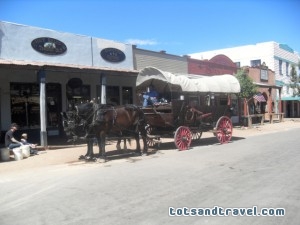
Stagecoaches and covered wagons still fill the streets
Driving into town with our travel trailer, we were immediately stopped by a stagecoach in the road! This was our first hint that Tombstone is a different sort of experience. We stayed at the Wells Fargo RV Park, an incredibly friendly and reasonably-priced park literally next door to the O.K. Corral. We picked out our site and turned off the car. We would not turn it on again all week except to drive to Bisbee, a mining town turned arts community a few miles up the road. We also took the car to Boot Hill, though we could have visited by trolley had we so decided.
Getting around Tombstone Arizona is incredibly easy. The Historic District is six blocks long by three blocks wide–and each block is less than the half the length of a modern city block. The area is roughly bounded by the O.K. Corral at one end of Allen Street, the main road through the Historic District, and the Birdcage Theater at the other. Vehicles are not permitted on the historic portion of Allen Street, but free visitor parking is available at either end of town. Public restrooms are located near the parking lots, and the restaurants have facilities for their customers. The town is reasonably wheelchair-accessible.
Tombstone Trolley
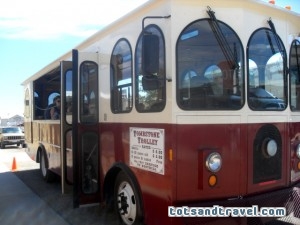
The Tombstone Trolley was great for disabled and able-bodied alike
At the recommendation of the RV park owners, our first order of business was a trolley tour. We always like to get a narrated overview of each place we visit before exploring in more detail on our own, and the park owners assured us that Tombstone Trolley was well worth the price. They were absolutely correct!
The 25-minute trolley ride departs from the corner of 4th and Toughnut Street, behind the Tombstone Art Gallery and across from the Big Iron Shooting Gallery (where you can fire an authentic 1800s Colt six-shooter for just $3). Trolleys leave every half-hour throughout the day. At 2011 prices of $5 for adults and $3 for kids aged 6 to 12 (5 and under are free), it is an incredible value.
The highly knowledgeable trolley drivers provide a fully-narrated tour of the Historic District, sharing stories and legends of some of the town’s most infamous residents. At various points, representatives of other local businesses, such as the Good Enough Mine Tour and the O.K. Corral, board the trolley to speak for a moment about their attractions. But they are actors rather than salespeople, and the experience feels authentic and fun rather than like a sales pitch.
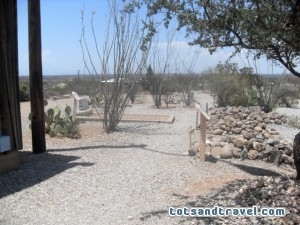
Tombstone's most infamous residents are buried in Boot Hill
The trolley also goes to the Boot Hill cemetery, a few blocks up the main highway from the Historic District. Although it is within walking distance, the highway is heavily trafficked and lacking in sidewalks. You can depart the trolley at the cemetery and catch a ride back on the next one 30 minutes later. We decided to wait and take our car to Boot Hill another day, to allow ourselves more time to explore, but as it turns out 30 minutes is about right.
The trolley is fully wheelchair-accessible via a lift, and is the only accessible public transportation within the Historic District. The narration mixes historical facts with puns and jokes, creating a spiel that captures the attention of all ages. We highly recommend this tour for everyone! An evening Ghosts and Murders tour covers Tombstone’s grisly past, but we did not have the opportunity to take that ride.
Old Butterfield Stagecoach

This stagecoach was actually built in the 1860s!
It seems like every time you turn around in Tombstone, you will see another old-fashioned, horse-drawn vehicle. Stagecoaches and covered wagons vie for attention on virtually every street corner. But if you are going to shell out for a ride, why not go for authenticity? The Old Butterfield Stagecoach is the only one that was actually built in the 1800s. All the others in town are reproductions.
The stagecoach entered service in the 1860s as a mail coach along the old Butterfield route from St. Louis to San Francisco. The trip originally took approximately three weeks, with as many as six passengers crowded into the tiny coach. There were four in our group, and I honestly don’t know where two more would have fit!
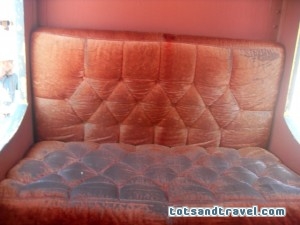
The vintage seats are worn but so comfortable
The coach is kept in safe transport condition, but has not been “restored.” The original paint and velour seat covers are showing definite signs of wear, which I was glad to see. I prefer for historical artifacts to look historic, rather than brand new.
The 20-minute ride covered most of the same sites as the trolley, but we were more interested in the experience of the stagecoach itself. We were warned that it was a bumpy ride, but we just thought it was fun. Then again, we both adore bone-rattling old wooden roller coasters, so we may not be the best judges! But the elderly gentleman with a portable oxygen tank who rode with us seemed perfectly comfortable. As of 2011, the ride costs $10 for adults and $5 for children. Kids aged 5 and under are free.
Shopping and Dining in Tombstone

Big Nose Kate's is just one of several historic saloons in town
Tombstone’s Historic District is lined with fascinating shops that sell a plethora of interesting memorabilia. In sharp contrast to many tourist towns, T-shirts are not the only souvenir. Handmade crafts by local artisans, Western clothing and a wide range of antiques abound. In this era of bookstore closings and e-readers, I was thrilled to find a mind-boggling assortment of books. Western history is the predominant theme, from photo essays to biographies. Pay attention as you shop, as most spots have signage describing the original 1880s tenants. Some major gun battles took place in what are now shops.
It is tough to find a bad meal in Tombstone. In its heyday, Tombstone’s streets were lined with saloons. Today most of them have retained the original décor, but now serve food to all ages. We were particularly impressed with the Crystal Palace, the Longhorn, and Big Nose Kate’s, but would not hesitate to try the others as well.
Tips for Parents
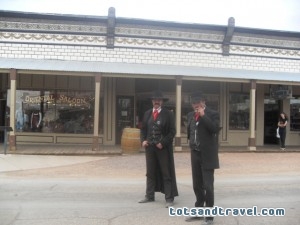
You can find gunfighters on the street and in multiple shows
Carry plenty of cash. Nothing is expensive in Tombstone, and those from big cities may be quite surprised at how low prices actually are. But there are endless opportunities to shell out a few dollars for an authentic Western experience, from firing an antique gun to posing for old-time photos. Although it is not required, all of Tombstone’s various performers and tour guides accept tips, so make sure you have plenty of singles.
If your kids are old enough, let them carry their own spending money. Cheap but fun souvenirs are plentiful, providing a wonderful opportunity to teach a lesson on budgeting. Some parents prefer to give kids their entire spending budget at once, with the caveat that once it’s gone, it’s gone. Others dole out a portion each day, so that if kids make poor choices one day, they have the opportunity to try again the next.
Carry lots of water each day. Front porches along each building offer awnings and benches, providing space to rest in the shade. But the streets and many of the activities are in full sun, and it is easy to get dehydrated. Tightly capped bottles of water are allowed in virtually every location. Sunscreen and a hat are also essential.
Related Tombstone Arizona Articles:
The Bird Cage Theater: A True Time Capsule of the Old West
The Good Enough Mine Tour: The Source of Tombstone’s Wealth
Gunfights of Tombstone, Arizona

|
 About the Author:
Sorry, the comment form is closed at this time.