
Pecos, Texas: A Tiny Oasis in the Wilds of West Texas
July 17, 2011 No Comments
West of the Pecos is one of the best Western museums we've found
Dad and I learned a very interesting lesson during our Western adventure this summer: Texas is a big state. Of course, we already knew the facts and figures, but maps simply do not do it justice. Even more importantly, we learned that West Texas is desolate. When we left San Antonio, headed for Carlsbad, New Mexico, we knew we were in for a long drive. So we planned a two-night stop in Pecos, Texas.
What we didn’t realize was just how welcome that tiny town would be. After 5 or 6 hours of sheer nothingness, we were extremely ready to get out of the car and stretch our legs. A big sign advertised Pecos as the home of the world’s first rodeo, which took place on July 4, 1883. The locals were friendly and welcoming, but the town was unbelievably small! With a handful of restaurants and not much else of interest, it was hard to believe that this is the county seat and biggest city in Reeves County.

The Railroad and Telegraph Room was a special favorite
Settled in 1873, Pecos was an important trading point for many of the Old West’s most famous routes. The Goodnight-Loving Trail, the Chisholm Trail and the Butterfield Stagecoach route all passed through Pecos. The Texas and Pacific Railroad came to town in 1881, further establishing Pecos as a supply center for settlements within a 200 mile range. World War II gave Pecos another boom era when the town received one of the largest military training centers in the country. The oil and gas industries arrived in the 1960s, providing prosperity until the 1980s oil bust.
Today, Pecos Texas primarily relies on an agricultural economy, though the town also embraces tourism, offering “true West Texas hospitality.” As it turns out, Pecos is also home to one of the best Western museums we have discovered anywhere.
West of the Pecos Museum

The audio-animatronic bartender was cute
During the boom years of the late 1800s, Pecos travelers needed somewhere to stay. Former Texas Ranger R.S. Johnson opened a saloon with upstairs lodging in 1896. In 1904, the building was expanded into the elegant three-story Orient Hotel. The hotel closed in the 1950s, and was converted into a museum in the 1960s. As of 2011, admission is $4 for adults, $3 for seniors over age 65, and $1 for kids aged 6 to 18. Children under 6 are free.
The docent at the ticket counter gave us a brief overview of the museum before sending us on our way. The tour begins in the saloon, where an audio-animatronic bartender tells the story of a historic gunfight. Apparently one night in 1896, a local resident named Barney Riggs shot and killed noted outlaws John Denson and Bill Earhart. You can see the bullet holes in the wall and plaques on the floor where they fell.

Pecos Bill could even ride a tornado
The former hotel rooms have been turned into well-organized exhibit spaces, each highlighting a specific element of Western life. The Railroad and Telegraph room was a particular favorite, packed with everything from old lanterns to an elaborate ticket window. An entire room is dedicated to rodeo history; another has been converted into a pioneer kitchen; yet another is decked out as a bridal suite.
Dad was particularly excited to discover the Pecos Bill room. As the legend goes, Pecos Bill was the youngest of 18 children. Lost in the Pecos Mountains, he was raised by coyotes and considered himself a coyote until he was discovered by his cowboy brother. He then became the most impressive and unstoppable cowboy in the West, inventing all sorts of tools and taming all manner of animals. It is said that he was even able to ride a tornado like a bronco. Having grown up on the stories of Pecos Bill, Dad reverted to childhood as he excitedly took in the various displays!
Tips for Parents
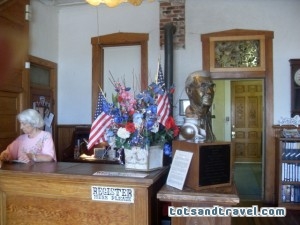
The docent was great at answering questions
The West of the Pecos Museum is huge, with three floors of exhibits. The stairs are fairly steep and narrow, so keep a close eye on the kids. The museum is relatively old-fashioned, relying on artifacts and informational signs rather than modern multimedia displays. Plan to read and summarize the information for younger kids.
Expect lots of questions. Many of the items are exotic by today’s standards, and there is no telling what may catch a child’s eye. Follow their lead and focus on their interests, rather than expecting them to pay attention to everything.
Dad and I spent more than two hours examining the displays. If we hadn’t gotten hungry, we could easily have stayed for another hour or more. The museum is fascinating, and it is easy to get caught up. Plan your visit for a day when you have time to spend.

|
 About the Author:
Sorry, the comment form is closed at this time.