
Arizona’s Verde Valley: Clarkdale, Cottonwood and Tuzigoot
August 16, 2011 No Comments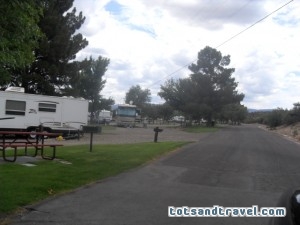
The RV park was wonderfully scenic
Arizona’s Verde Valley region was settled in the late 1800s and early 1900s to support copper mining in the local mountains. By the 1940s, however, the copper boom was over and the region was nearly deserted. Today the area is an interesting mix of retirees and artists, many of whom settled in the region during the 1960s, when the hippie culture was at its peak.
Dad and I discovered the Verde Valley by accident. We are members of the Thousand Trails campground system, and decided to stop by the membership park in Cottonwood on our way to Nevada. Little did we know that we would stay busy for a full three weeks.
Clarkdale

Many of Clarkdale's historic buildings still stand
Clarkdale was a true company town, in every sense of the word. Built by Montana Senator William A. Clark, owner of the United Verde Copper Company, Clarkdale existed to provide smelter services for the copper mine in nearby Jerome. A small, private train, now the Verde Canyon Railroad, transported ore between the two towns.

The Clarkdale Museum is small but fascinating
Clark believed in keeping his employees happy, so he provided all the services that they could need or want. The town was built in 1912 according to a strict master plan, and most of the buildings still stand today. Clarkdale’s heyday ended when the mines closed in the 1940s, forcing many long-time residents to move to other cities for work. Dad and I were fortunate enough to meet one such resident, a teenager when her family had to move, at the Clarkdale Historical Society and Museum.
The museum is open extremely limited hours, so call before your visit to confirm that it will be open. Packed with Clark-era artifacts, it is worth the trouble. Besides our chance meeting with the former resident, we were given a guided tour by a highly knowledgeable docent. She was proud of the town and eager to show off the things that made it special. There is no admission fee. If you have a few extra minutes after your visit, take a drive through downtown. The homes and buildings are remarkably well preserved, offering a look at the way life used to be.
Cottonwood

Cottonwood's Historic District is easily walkable
Once known as the “Biggest Little Town in Arizona,” Cottonwood was founded in 1879 by families eager to profit from farming contracts with the nearby military Camp Verde. The area boomed, eventually attracting a lawless element. During Prohibition, Cottonwood was one of the best-known bootlegging centers in the West. Meanwhile, legitimate businesses also blossomed, offering more shops and restaurants per capita than any other town in the United States.

The Clemenceau Museum has an excellent staff
Today Cottonwood is thriving, with a population of roughly 6,000 residents. Cottonwood’s historic district is filled with independent shops, top-notch yet unpretentious restaurants, and a variety of art galleries. Cottonwood also offers a plethora of support services, such as grocery stores and gas stations, for the entire region.
Cottonwood’s major tourist attraction is the Clemenceau Museum. Free of charge, the museum is open irregular hours, so call ahead. Housed in a former elementary school, the surprisingly expansive museum offers something for everyone, from antique furniture to model railroads. One room is still set up as an old-fashioned classroom. Interestingly, it is the same room where one of the museum docents once attended classes.
We were given a private walking tour of the museum. Our guide, an older gentleman, brought the artifacts to life by explaining their use in his own life as a small child. The model railroad expert was a virtual encyclopedia of both model trains and the local area, and was a fascinating storyteller who kept us riveted.

The Old Jail was worth a quick look
Don’t miss the Old Jail. Now a visitor center that is open extremely limited hours, the Old Jail is small but interesting. Our guide was a quirky local full of stories and information about Cottonwood’s past.
Dining in Cottonwood runs the gamut from fast food to casual elegance. Owned by the same family that operates the famed Haunted Hamburger and the Grapes restaurant in Jerome, both the Tavern Grille and Nic’s are well worth a visit. Locals also swear by the Verde Lea Market, an unassuming independent grocery store with a full-service deli in the back.
Tuzigoot National Monument

Tuzigoot National Monument has a surprisingly detailed museum
Of course, the miners were not the first to settle in the Verde Valley. Ancient Native Americans known as Sinagua constructed an elaborate pueblo just outside modern-day Cottonwood. The oldest portion of the 110-room pueblo dates to roughly 1000 AD. Known as Tuzigoot, Apache for “crooked water,” the pueblo is believed to have been a compact village where a sizeable tribe lived, worked, played and worshiped. For reasons that have puzzled archaeologists for decades, the Sinagua abandoned the region around 1400 AD.
Today the pueblo ruins are a designated National Monument. As of 2011, adult admission is $5 for seven days. Kids under age 16 are free. The site accepts National Park passes.
An expansive and extremely well-done museum and visitor center is the first stop. Through artifacts found on the site, old documents and maps, interactive computer terminals and elaborate signage, the museum tells both the story of Tuzigoot’s people and the history of the archeological research on the site.
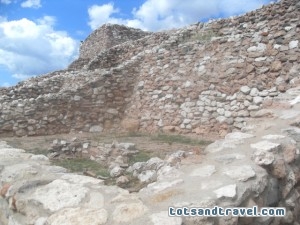
The pueblo was quite a sight!
Dad and I planned to spend a half-hour or so in the museum before exploring the ruins. The weather was brutally hot, and we wanted to see the ruins in the cool early morning. But the museum was so engaging that we ended up spending nearly two hours inside!
Outside, a trail roughly one-third of a mile in length winds around and through the ancient pueblo. The trail is paved and relatively easy, but it is fairly steep. A bench is available at the top. The old pueblo has been carefully preserved, and it is easy to step back in time. The view from the rooftop blends the old with the new, offering a look at modern-day Cottonwood, the historic mining town of Jerome, and the ancient Verde Valley.

|
 About the Author:
Sorry, the comment form is closed at this time.