
The Bird Cage Theater: A True Time Capsule of the Old West
August 7, 2011 No Comments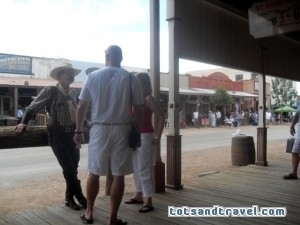
Sometimes the locals just dress up for fun
Tombstone, Arizona is a lot of fun. Both professional reenactors and local residents wander the streets in full Wild West regalia, joining the tourists at the Crystal Palace for a cold beer or simply relaxing on a bench watching people pass by. Historic tours and staged gunfights bring the feeling of the Old West to life. But some purists argue that the Tombstone of today is largely manufactured. Reconstructed buildings, dubious timelines and tall tales have in some ways turned Tombstone into a living piece of mythology rather than a fully-accurate depiction of life in the 1880s.
But one building remains an indisputable historic artifact, a living monument to Tombstone’s golden era, when Wyatt Earp, Bat Masterson, the Clantons and the McLaurys passed their time in the town’s saloons and gambling houses. The Bird Cage Theater might have suffered the same indelible imprints of time as the rest of Tombstone, had fate not intervened.
Bird Cage History
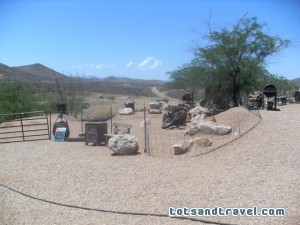
Tombstone was built to support the mines that run below
Boom towns in the Old West generally had two main categories of residents: the rough and tumble miners and the somewhat more refined mine owners. Everyone else generally worked in a support industry. While the miners were often single, the mine owners often brought their families to town.
Boom towns of any size had to balance the needs of both types of residents–building schools, churches, opera houses and dress shops for the families, and gambling houses, saloons and brothels for everyone else. Invariably, these diversions also drew a large population of transients–outlaws and professional gamblers who stayed for a few days or weeks at a time before disappearing into the sunset. They were tolerated, and in many cases welcomed, because they always had money to spend.
It was in this spirit that the Bird Cage Theater got its start. The doors opened on Christmas Day, 1881, just three months after the infamous gunfight at the O.K. Corral. Home to roughly 20,000 residents, Tombstone was flush with men eager to spend their ready cash on women, gambling and alcohol.

Outlaws and gunfighters were prevalent in Old Tombstone
Within its first year, the Bird Cage developed the reputation as the wickedest, wildest spot west of New Orleans’ Basin Street. With live entertainers such as Lillian Russell and Lillie Langtry on stage, the Bird Cage also offered less respectable entertainment. Faro was the card game of choice for many men of the era, and a table in the main room allowed gamblers to keep an eye on the performance. The balconies on either side held “cribs,” referred to as “bird cages,” where high-dollar ladies of the evening could draw a curtain for privacy while entertaining their clients.

This poker game lasted for more than eight years straight
Downstairs, a never-ending poker game was just steps away from another set of cribs. The minimum buy-in to the poker game was $1,000–or roughly $22,000 in today’s money! Would-be gamblers placed their names on a list, sometimes waiting as long as 4 days for a seat at the table.
The Bird Cage Theater was open 24 hours a day, 365 days a year. Always packed with rough and ready frontier men, virtually all of whom were drunk and carrying firearms, and ladies of the night, who were by necessity armed and always ready to fight, the Bird Cage saw more than its share of violence. It is unclear exactly how many gun battles and knife fights occurred, but it is estimated that 26 lives were taken. The theater is riddled with 140 bullet holes.
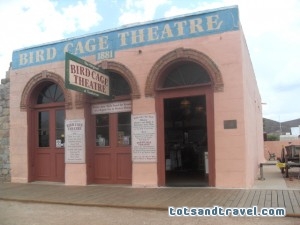
The Bird Cage sat boarded up for nearly 50 years
The Bird Cage escaped the Tombstone fire of 1882, but was in the potential flood path when the mines flooded in 1889. The theater owners carefully boarded up the property before fleeing. Though the theater was undamaged, the town was virtually abandoned. It was not until early promoters developed Tombstone’s tourist trade in 1929 that the town began to rebound.
The Bird Cage sat abandoned, its doors and windows still covered by their original boards, until new owners opened it in 1934. Incredibly, the theater was still in surprisingly good condition. The Hunley family made as few changes as possible, bringing in some museum-style exhibits but leaving the original furnishings in place. Within a few months, they opened the theater as a tourist attraction. Consequently, it remains a sort of time capsule, a chance to step back into the 1880s as they were rather than as they are portrayed today.
Our Visit to the Bird Cage

The entrance sets the stage for what will follow
**Note** Personal photography is permitted inside. However, you must get written permission to post photos anywhere online, including Facebook.
As of 2011, daytime admission to the Bird Cage is $10 per person. The evening ghost hunt is $20 per person, and is not recommended for children. The daytime tour is self-guided, and your ticket is valid all day. You are welcome to come and go at your leisure from 9 a.m. until 6 p.m.
The front room houses a small gift shop and ticket counter along with a few historical artifacts. It was cool, but not that different from other historic buildings that we have visited. As soon as we stepped through the door into the main part of the theater, however, our jaws dropped.
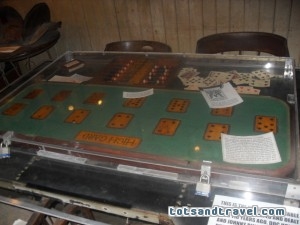
Bat Masterson and Doc Holliday played faro on this table
Although it sounds incredibly cheesy, the door felt like a literal portal, whisking us back in time to the 1880s. The antique wooden floor boards creaked beneath every step. The musty scent of dust, decay and the passage of time was thick in our nostrils as we gazed dumbfounded around the room. At the far end was the stage, with the grand piano directly in front on the main floor and the faro table slightly to my left of the piano. Above us on the balconies were the original bird cages–the cribs in which the ladies of the evening entertained their clients.
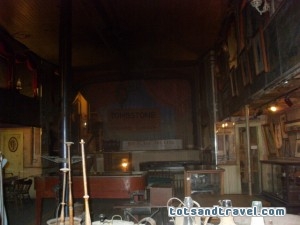
We hardly knew where to look first!
Throughout the main floor were glass cases containing all manner of artifacts. Dad got down to business, the camera shutter flying as he attempted to capture everything on film. I took a slow, purposeful walk around the perimeter of the room, trying to drink in every detail. Carefully written informational signs explained each new thing that I discovered.
Gradually we made our way to the stage, where a staircase at stage right invited us backstage. After stopping to examine the bullet holes made when an onlooker decided to send the performer a message, we climbed onstage. Gazing out towards the main floor, it was easy to imagine Bat Masterson and Doc Holliday facing off over the faro table.
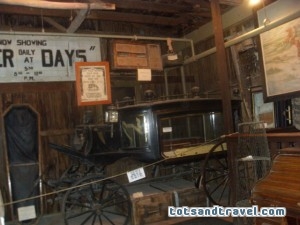
A mix of original props and movie props backstage
Backstage were new discoveries. Props, set pieces and random objects from long-forgotten performances still sat where they were left on that fateful night in 1889. Some of the bigger props stored underneath the stage looked like they would require very little work to be pressed back into service for another play.
Scattered backstage were additional artifacts from the town’s history, including various articles of clothing and even a horse-drawn hearse. A few more recent movie props were back there as well, including an ornate casket created for the movie Tombstone. Photos of past performers hung on the walls.
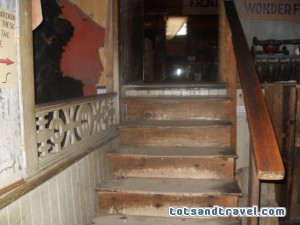
What lies at the bottom of the creaking wooden staircase?
While making our way down the wooden steps to the basement, I felt sort of like we were entering the inner sanctum. The ladies’ small bedrooms, which also served as cribs, lined the wall. Directly across from the cribs was the site of the famous eight-year poker game, abandoned the night of the flood. The tables were strewn with coins, cards and chips, giving the distinct impression that the players had left in a hurry. A small bar underneath the main stairs was ready to serve players whatever libations they might desire. At the far end of the room, a shorter staircase, now blocked off, led to the main floor.
All too soon, it was time to exit through the main gift shop. We spent roughly two hours inside, and easily could have spent two more. The Bird Cage Theater captivated our imaginations in a way that few tourist attractions have managed to do.
Tips for Parents
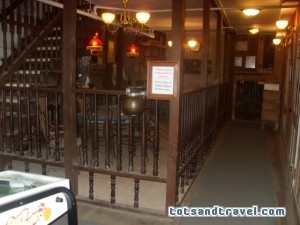
Downstairs felt like the inner sanctum
The Bird Cage Theater is a terrific stop for families of all ages. Several groups touring at the same time as we were had young children, and they all seemed fully engaged. The sense of history and urban exploration is powerful, and seemed to affect everyone in an almost visceral way.
Be prepared for questions. Many of the artifacts are exotic and eye-catching by today’s standards. The topic of prostitution is sensitively handled, and nothing inappropriate is visible. I heard more than one parent explaining the downstairs cribs as bedrooms for women who worked in the theater, which is certainly a truthful yet age-appropriate explanation.
Be receptive to your kids’ attention spans. While the theater is engaging, it is also overwhelming. Since you are free to come and go all day, it may be best for families with young children to explore one section at a time, taking a break to play outside in between.

|
 About the Author:
Sorry, the comment form is closed at this time.